
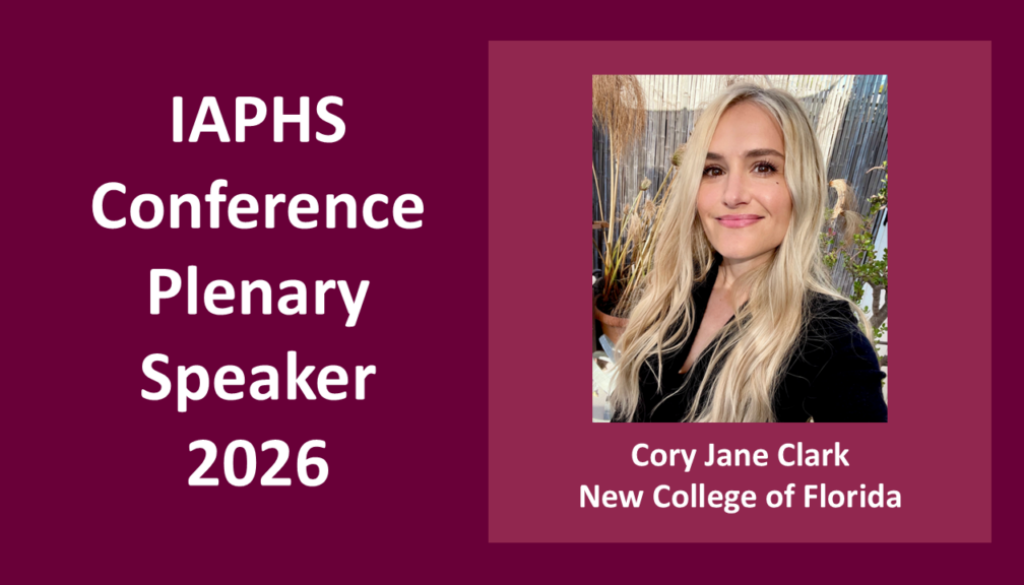
Conference Preview: Cory Jane Clark on Adversarial Collaboration
Claire Altman
Our IAPHS Blog Editor interviewed Cory Jane Clark about the IAPHS Conference September 29-October 2, 2026, in Portland, Oregon. Cory is a plenary speaker along with Sandro Galea and Brian Nosek. The topic: “Research for Impact: New approaches to production and publication.”
Claire: Why did you agree to present at IAPHS this year?
Cory: I wasn’t previously familiar with the conference, but I was drawn to the topic — adversarial collaboration — and the opportunity to bring a new approach to a different research audience.
Claire: What is adversarial collaboration?
Cory: It’s an approach where scholars with competing perspectives work together on the same research project instead of operating separately. The goal is to design stronger studies, reduce bias, and produce more credible evidence.
Claire: How did you become interested in this approach?
Cory: My interest was influenced by Phil Tetlock and Daniel Kahneman, particularly their work on bias and scientific disagreement. I became interested in finding ways to make those disagreements more productive.
Claire: Why should researchers be interested in this approach?
Cory: It pushes researchers to refine their ideas more rigorously and confront opposing evidence directly. While collaborators may not always reach agreement, the process typically leads to better science and greater mutual understanding.
Claire: What does adversarial collaboration look like in practice?
Cory: I’ve helped facilitate collaborations where opposing scholars jointly design studies and interpret results. These projects often surface disagreements but also build respect and clarity around where differences truly lie.
Claire: How might this apply to population health science?
Cory: It’s especially useful for empirical debates—like those around family structure or health outcomes—where researchers often have competing interpretations. Working together could improve measurement, methods, and the credibility of findings.
Claire: What are some challenges of this approach?
Cory: It can be difficult to collaborate with scholars you’ve previously criticized, and it requires trust and strong moderation. Clear definitions — like what we mean by “well-being” — are also essential to avoid talking past one another.
Claire: What excites you about presenting at IAPHS?
Cory: I’m excited to introduce this idea to a new, interdisciplinary audience and to learn how it resonates in population health. Changing norms in science requires reaching beyond our usual circles.
Claire: Do you see this approach influencing your own work or others’ work?
Cory: Absolutely. It can improve both the quality of research and professional relationships. I’m even happy to help facilitate or moderate collaborations if others want to try it.
Registration is OPEN. Click Here to Register Today!
Note: This conversation was summarized with the help of AI.

All comments will be reviewed and posted if substantive and of general interest to IAPHS readers.