
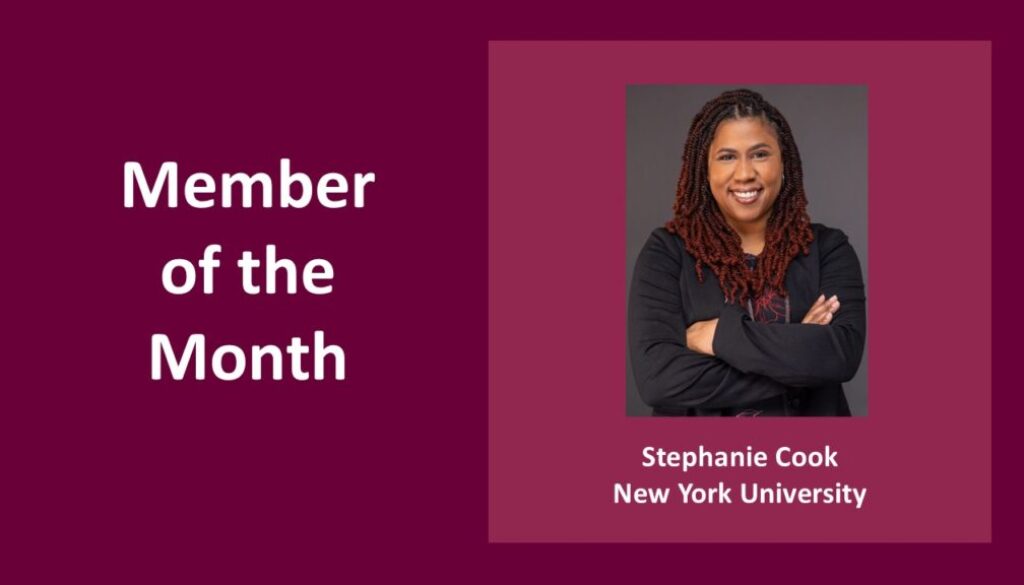
Member of the Month: Stephanie Cook
IAPHS Staff
Stephanie Cook
New York University
What discipline(s) does your research fall under?
My research sits primarily in health psychology, biostatistics, and psychoneuroendocrinology, with a focus on intersectionality and how structural conditions shape biological and behavioral health.
What other disciplines pique your interest? Are there additional disciplines you are interested in incorporating in your own research?
I am especially interested in integrating data science, AI/ML, and spatial science into my work, along with qualitative methods that capture lived experience. I’m also increasingly interested in human–AI interaction and how digital environments shape stress, behavior, and health.
What is your favorite thing about IAPHS?
The intellectual openness. People are willing to engage across disciplines and take complex ideas seriously without forcing them into narrow frameworks.
What brought you to IAPHS?
I came to IAPHS because I wanted to be part of a community that values intersectionality research in a real, substantive way. My work sits at the intersection of social context, structural inequality, and health, and I was looking for a space where that complexity is understood rather than simplified. Dr. Patricia Homan played a key role in that process by introducing me to members of the organization, which helped me build meaningful connections and a sense of community early on.
Will you be at the conference this year?
No, I will not be attending this year.
What are you planning to do in the future? Goals for the next five years?
Over the next five years, I plan to build a program of research that advances intersectional population health by integrating spatial data, real-time measurement, and biological markers. This includes extending my digital weathering work, expanding the GEOSENSE+ platform, and advancing my Google AI–focused projects to better understand how digital environments shape stress, behavior, and health. The goal is to develop scalable tools that not only measure inequities but also actively help reduce them.
What do you do for fun?
I spend a lot of time with my kids, which is both fun and chaotic. I also run and train for half and full marathons, which gives me space to think and reset. I enjoy being outdoors, traveling when I can, and exploring ideas that sit just outside my main research area.
What book or movie have you recently read/seen and why would you recommend it?
I’m currently reading Kin by Tayari Jones. Her work consistently explores complex family dynamics and social context in a way that feels both grounded and sharp. It stays with you after you finish.
What’s the best advice you’ve ever heard?
It all starts with a well-structured question. The method can change, but the question is what gives the work meaning.
Also, just ask. The worst they can say is no, and you can handle a no. Missing an opportunity to collaborate or pursue funding can slow progress more than rejection ever will.
If readers want to reach you, what’s the best way to contact you?
Email: sc5810@nyu.edu
Website: https://www.healthdisparitieslab.net/
All comments will be reviewed and posted if substantive and of general interest to IAPHS readers.