
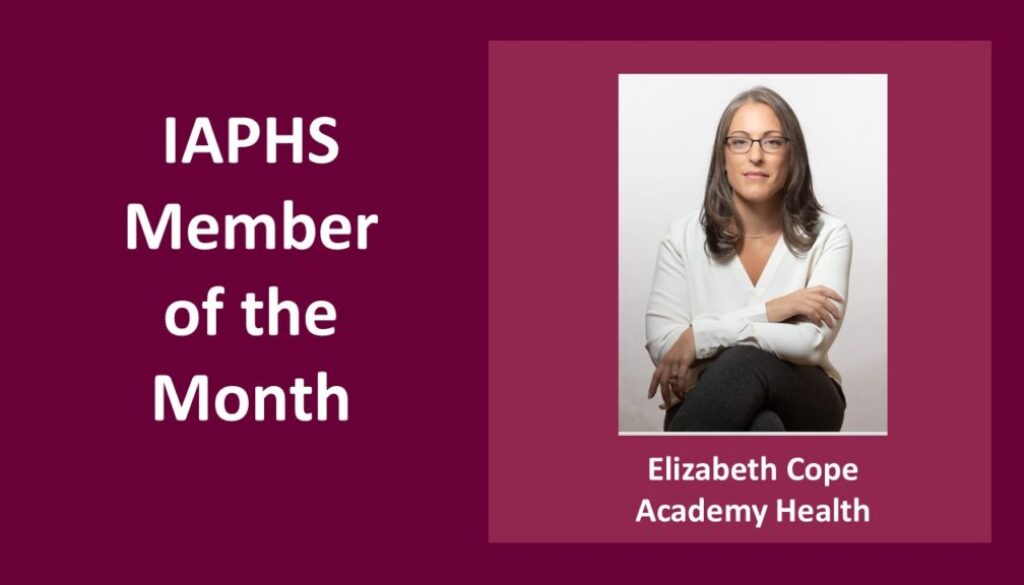
Member of the Month: Elizabeth Cope
IAPHS Staff
Meet Elizabeth L. Cope, Ph.D., M.P.H., Chief Programs & Science Officer at AcademyHealth.
What discipline(s) does your research fall under?
While I am formally trained in epidemiology and anthropology, my career has spanned academia, FQHCs, CMS policy, and community organizing. My winding path brought me to where I am now, where most of my work sits firmly in implementation and improvement science. Here, I get to pull from across many disciplines to focus on ensuring health service delivery is both evidence-based and deeply humanizing.
What other disciplines pique your interest? Are there additional disciplines you are interested in incorporating in your own research?
To be honest, all of them! That is the beauty of population health. I am a problem-solver by nature, so I am open to any discipline that provides a tool to solve the challenge at hand. This mindset has allowed me to collaborate with people across a massive spectrum of lived and learned experiences, from clinical decision support to trustworthiness and rare disease advocacy.
What is your favorite thing about IAPHS?
It is remarkably ego-less. It is one of the few spaces where you will see world-renowned senior leaders engaged in deep, meaningful shop-talk with students. Because of the incredible heterogeneity of backgrounds, you are guaranteed a fresh perspective that challenges your bubbles. It is the perfect size for rich, authentic discussion.
What brought you to IAPHS?
I was introduced to IAPHS in 2016 by two incredible mentors and colleagues, Sanne Magnan and Mike Stoto. At the time, they were helping me navigate the intersection of population health, collective impact, and CMS quality improvement policy. As that project wrapped up, they suggested I join this burgeoning organization because it mirrored the exact kind of cross-sector work I was passionate about. They were absolutely right — I found my professional home here.
Will you be at the conference this year?
Absolutely! As the current lead of the Communications Committee, I have had a front-row seat to the exciting work being featured. It is one of my favorite events of the year — I always try not miss it for anything.
What fictional place would you like to visit?
I would choose Scheria, the island of the Phaeacians from Homer’s Odyssey. I have always been fascinated by their society. It is a liminal space where the maritime and the mystical meet. The Phaeacians are the ultimate cross-disciplinary collaborators; they are master navigators whose ships are steered by thought and intention rather than oars. What draws me most to Scheria is their culture of xenia (hospitality). They created a space where a weary traveler could be welcomed, heard, and supported, eventually provided with what they needed to reach their true home. It feels like the ultimate sanctuary defined by seafaring wisdom, a flat social hierarchy, and an unwavering commitment to helping others bridge the gap between where they are and where they need to be.
What do you do for fun?
I have been practicing dressage and combined training since I was seven years old. It is my primary source of mindfulness. The sport requires intense mental presence and physical harmony to achieve precise communication with the horse. It is a rewarding practice in emotional regulation and patience that keeps me grounded outside of my research.
What’s the best advice you’ve ever heard?
“Trauma is not your fault, but healing is your responsibility.” It is a challenging but deeply empowering mantra. It validates that the harm was undeserved while reclaiming personal agency. It is a reminder that while we may not be responsible for the breakage in our lives, we are the ones who must take the active steps — often supported by others — to repair and break the cycle.

All comments will be reviewed and posted if substantive and of general interest to IAPHS readers.